Starting December 13, 2024, Instagram is removing the ability to follow hashtags in the app. This change follows Instagram CEO Adam Mosseri’s recent video Story which explains that hashtags no longer help posts reach more people. This suggests that hashtags are no longer relevant on Instagram, but if that’s the case, why can we still use them?

How Instagram Uses Hashtags in 2025
The way Instagram uses hashtags has evolved over the years and as Instagram’s technology has become more advanced, its reliance on hashtags to categorise posts has diminished.
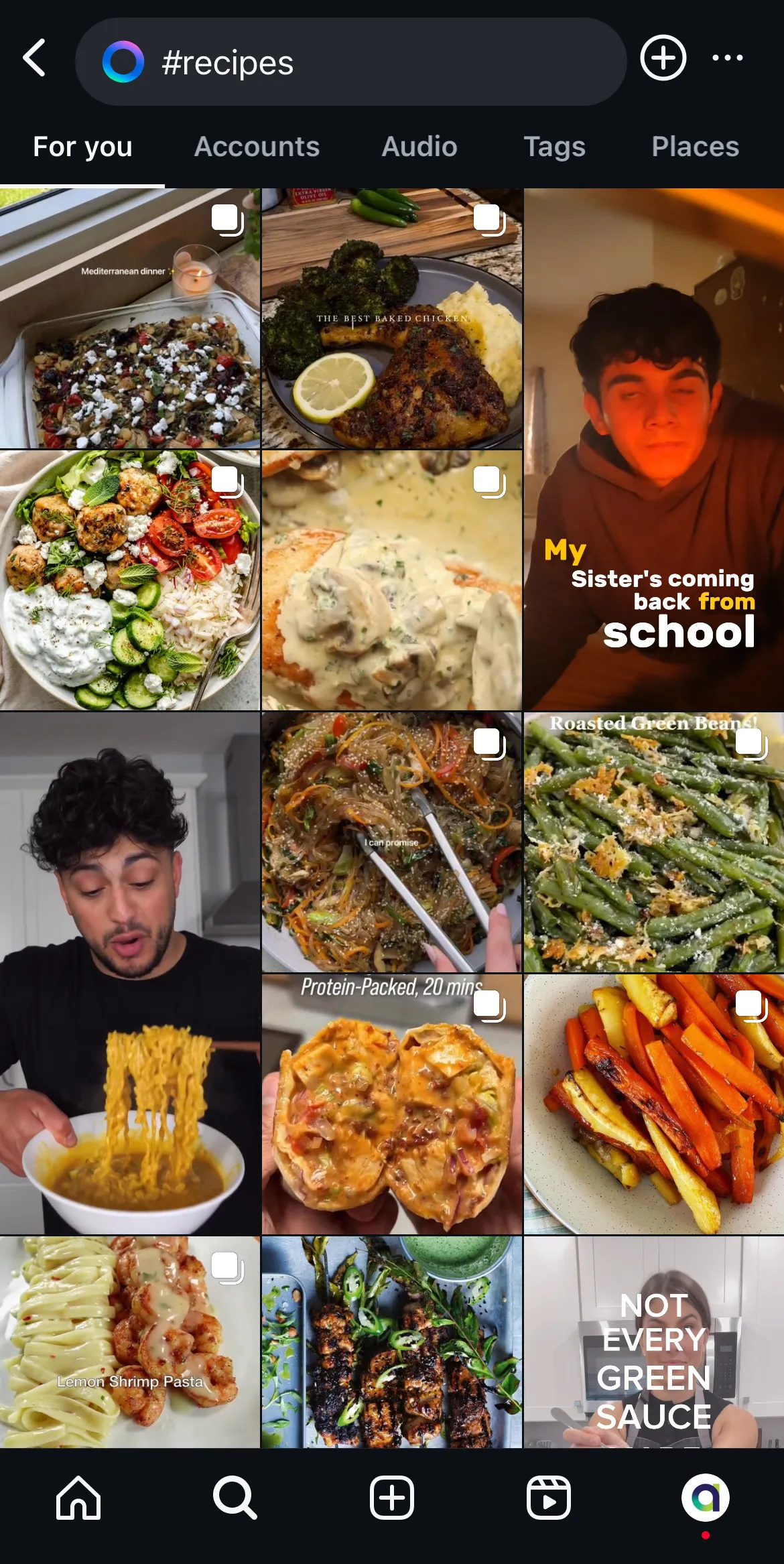
Originally, hashtags were essential for finding niche content. For example, users searching for recipe ideas could look up #recipes, and only posts tagged with that hashtag would appear in the results. Today, Instagram uses a more sophisticated approach.
Instead of relying solely on hashtags, Instagram now uses Social SEO to analyse content. Its algorithm scans through captions, images and videos to understand the context.
This makes hashtags less critical for discoverability.
How does Instagram know what my post is about?
If hashtags are no longer the primary way Instagram categorises posts, how does it know what your content is about? Well, it uses a combination of factors:
- Visual content analysis: Instagram’s AI examines the images or videos in your post.
- Caption keywords: Words in your caption play a significant role in helping Instagram determine your content’s topic.
- Bio information: Your profile bio helps Instagram align your content with your niche.
These advanced systems allow Instagram to connect users with content more effectively than hashtags ever could.
Should we still be using hashtags in 2025?
While hashtags no longer guarantee increased reach, they aren’t entirely obsolete. They can still provide context to the overall theme of a post. Note our earlier point about Instagram looking at the words that you are using in your caption.
The key takeaway from all of this is that hashtags are no longer the secret sauce to better reach, but they still contribute to your overall reach.
How to use hashtags effectively in 2025
If you want to increase your engagement, you need to think a little more creatively.
1. Base hashtags on SEO principles
Think of your hashtags like keywords for your website. Choose hashtags that reflect what your audience would search for, rather than focusing on popularity or volume like we once used to do.
2. Avoid Banned Hashtags
Did you know that there is a list of banned hashtags? Banned hashtags are hashtags that Instagram users have reported because the posts using them go against Instagram’s guidelines. This means that any post that uses that hashtag will be hidden.
View the complete list of banned hashtags here. We guarantee you’ll be surprised by some of these!
3. Switch up your hashtags
You no longer need to use the same list of hashtags on each post. Remember when we used to copy and paste the same list of 30 hashtags on each post? 😂 So 2015!
Tailor your hashtags to match the content of each post for better relevance and engagement. (See point one about Social SEO).
The Verdict: Do hashtags still work on Instagram?
In 2025, hashtags are no longer the driving force behind Instagram reach. Instead, the focus has shifted to content quality and SEO-driven strategies. To thrive on Instagram, prioritise creating high-quality posts and using captions that resonate with your audience. Hashtags can still play a supporting role, but they’re just one piece of a larger puzzle.
Remember: It’s not the hashtag that gets you noticed – it’s the value of your content.
- All
- AI Search & Marketing
- Digital Marketing
- Digital Strategy
- Ecommerce
- Google Analytics
- Instagram Stories
- Marketing
- Meta
- Search Engine Marketing
- Search Engine Optimisation
- Social Media
- Social Media
- Social Media Advertising
- Social Media Marketing
- Social Media Strategy
- Uncategorized
At the end of 2025, we wrote about the rise of the Slow Social Era - the idea that audiences are becoming more intentional with how they consume [...]
Are keywords dead? No, they’re not. But the way we use them has changed. Instead of focusing on one keyword at a time, we now need to [...]

Search is changing. For years, businesses focused on ranking in Google. If your website appeared on page one for the right keywords, customers could find you. Today, [...]

When marketers analyse ad performance, the instinct is often to focus on the obvious winners; the ads generating the most clicks, conversions or revenue. Those are the [...]
Well it's been 5 months since Google AI Mode officially launched in Australia and the effects on search behaviour, traffic patterns and SEO strategy are clearer and [...]
Most organisations are obsessed with reach - and so they should be. They want new audiences, new eyeballs, new followers - who doesn't? They pour budget into [...]
Recently we explored the Mere Exposure Effect - the psychological principle that says people tend to develop a preference for things simply because they’re familiar with them. [...]

For years, Meta ads were managed like a machine you had to constantly tweak. Adjust the bid strategy. Restructure the campaign. Turn off underperformers quickly. Optimise daily. [...]

If you're finding your Meta ads lately are becoming more expensive and less effective, the problem probably isn't your targeting or your budget. The Meta Ads algorithm [...]

For years, follower count was treated as the ultimate measure of success on social media. More followers meant more reach, more influence and more credibility. In 2026, [...]
At the end of 2025, we wrote about the rise of the Slow Social Era - the idea that audiences are becoming more intentional with how they consume [...]
Are keywords dead? No, they’re not. But the way we use them has changed. Instead of focusing on one keyword at a time, we now need to [...]
Search is changing. For years, businesses focused on ranking in Google. If your website appeared on page one for the right keywords, customers could find you. Today, [...]
When marketers analyse ad performance, the instinct is often to focus on the obvious winners; the ads generating the most clicks, conversions or revenue. Those are the [...]
Well it's been 5 months since Google AI Mode officially launched in Australia and the effects on search behaviour, traffic patterns and SEO strategy are clearer and [...]
Most organisations are obsessed with reach - and so they should be. They want new audiences, new eyeballs, new followers - who doesn't? They pour budget into [...]
Recently we explored the Mere Exposure Effect - the psychological principle that says people tend to develop a preference for things simply because they’re familiar with them. [...]
For years, Meta ads were managed like a machine you had to constantly tweak. Adjust the bid strategy. Restructure the campaign. Turn off underperformers quickly. Optimise daily. [...]
If you're finding your Meta ads lately are becoming more expensive and less effective, the problem probably isn't your targeting or your budget. The Meta Ads algorithm [...]
For years, follower count was treated as the ultimate measure of success on social media. More followers meant more reach, more influence and more credibility. In 2026, [...]