
AI tools like ChatGPT, Google Gemini and Perplexity are quickly becoming part of how people discover websites. Instead of searching Google directly, users are asking AI tools questions – and sometimes, those tools recommend your site.
But here’s the catch: GA4 doesn’t yet have a neat “AI traffic” channel – at least not yet anyway. If you don’t filter it out (or isolate it), AI referrals will get lumped into referrals or organic search, making it difficult to measure the impact.
But, you can create a custom segment in GA4 to track traffic coming from AI tools. Let’s show you how.
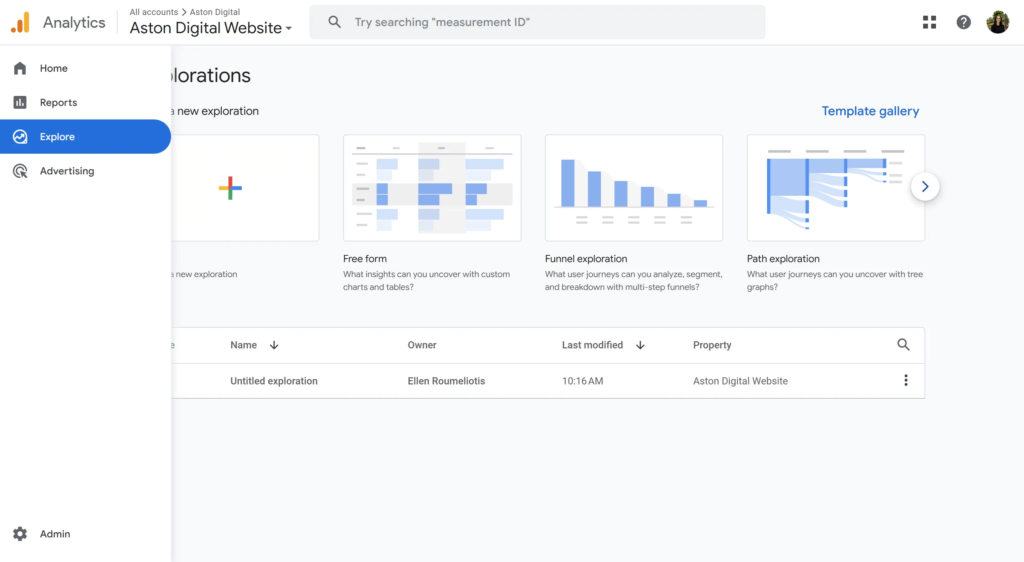
Step 1: Open GA4 Explorations
-
Log in to your GA4 property.
-
In the left-hand menu, click Explore.
-
Click + Create new exploration.
Step 2: Build a Segment for AI Tools
-
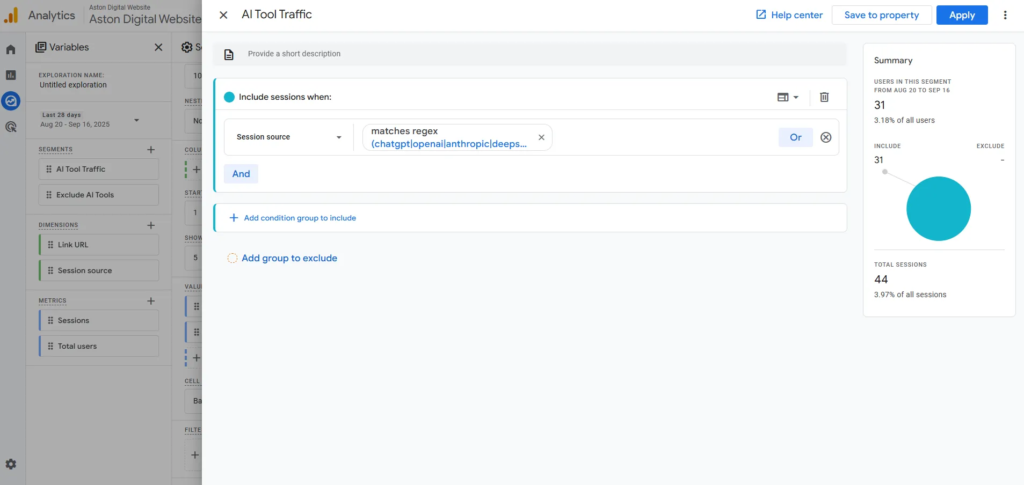
In your new exploration, click Add segment.
-
Choose Session segment.
-
Under Condition, select Session source/medium.
-
Change the match type to matches regex.
-
Paste in the following regex and click save:
(chatgpt|openai|anthropic|deepseek|grok).com|(gemini|bard).google.com|(perplexity|claude).ai|(copilot.microsoft|edgeservices.bing).com|edge\scopilot
This regex captures traffic from:
-
ChatGPT (when it links to your site)
-
Google Gemini
-
Perplexity search
-
Claude’s browsing
-
Bing Copilot
-
You.com AI search
-
Anthropic
Step 3: Create Two Segments
To get the most out of this analysis, you can create both:
-
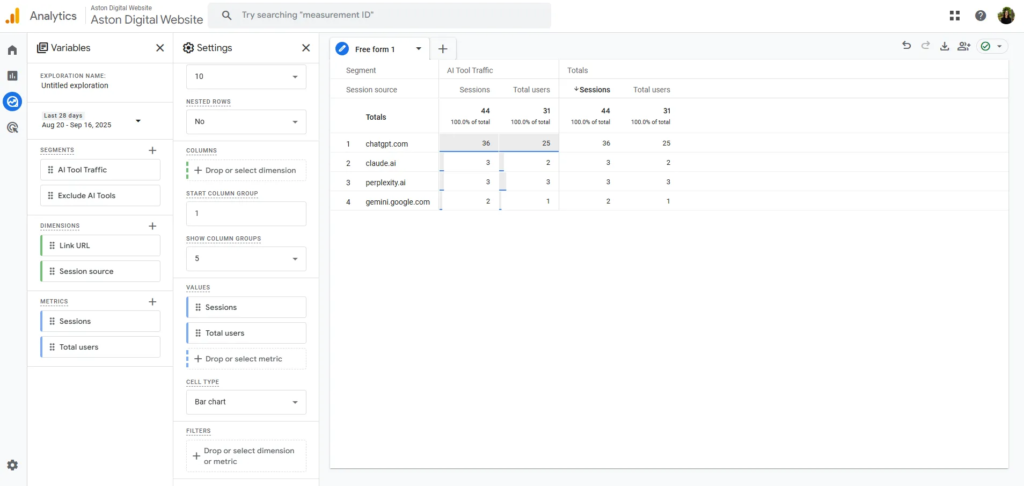
AI Tool Traffic: Shows only visits from AI tools (what we’ve created above)
-
Exclude AI Tools: Filters them out so your “traditional” traffic analysis isn’t skewed
Step 4: Analyse the Behaviour
Once applied, you can compare how AI-referred users behave versus your other channels.
Why is this important?
It’s a whole new channel of discovery that didn’t exist two years ago.
Your attribution models don’t yet account for AI referrals. But with this setup, you can start measuring it and get ahead of the curve.
Need help setting this up or interpreting the results? Get in touch with our team to uncover what AI-driven discovery means for your business.
- All
- AI Search & Marketing
- Digital Marketing
- Digital Strategy
- Ecommerce
- Google Analytics
- Instagram Stories
- Marketing
- Meta
- Search Engine Marketing
- Search Engine Optimisation
- Social Media
- Social Media
- Social Media Advertising
- Social Media Marketing
- Social Media Strategy
- Uncategorized

Starting December 13, 2024, Instagram is removing the ability to follow hashtags in the app. This change follows Instagram CEO Adam Mosseri’s recent video Story which explains that [...]

Consumers are becoming more emotive in their buying decisions and are craving genuine connections with brands. Enter low-fidelity (lo-fi) content. More than just a passing trend, lo-fi content [...]

Last week, Facebook announced a major update: 'Views' will now replace impressions as the primary metric for posts and Stories. This change aligns with Instagram's recent metric [...]

It’s the second week of November, and Black Friday promotions are in full swing; emails, ads, organic posts. But, how many of these promotions are you actually paying [...]
Google’s new search feature, AI Overviews, has recently launched in Australia, transforming how we interact with search engines. With AI-generated summaries now appearing directly in search engine [...]

TikTok can be polarising. Those who use it, love it. Those who don’t often find it confusing or aren’t sure how it could fit into their social media [...]

We’ve been geeking out over our latest Audience Intelligence Reports which rolled out to our clients over the last two weeks. Separate from our monthly digital marketing [...]
When you think about it, Pinterest is not really a social media platform but more of a search engine. While it does allow users to follow and [...]
When a social media post starts gaining traction, you’ll often receive prompts from the platform encouraging you to reach a wider audience by boosting the post. A [...]
In our last article, we explored the rise of zero-click searches and its impact on how we find information online. This shift in user behaviour has also [...]
Starting December 13, 2024, Instagram is removing the ability to follow hashtags in the app. This change follows Instagram CEO Adam Mosseri’s recent video Story which explains that [...]
Consumers are becoming more emotive in their buying decisions and are craving genuine connections with brands. Enter low-fidelity (lo-fi) content. More than just a passing trend, lo-fi content [...]
Last week, Facebook announced a major update: 'Views' will now replace impressions as the primary metric for posts and Stories. This change aligns with Instagram's recent metric [...]
It’s the second week of November, and Black Friday promotions are in full swing; emails, ads, organic posts. But, how many of these promotions are you actually paying [...]
Google’s new search feature, AI Overviews, has recently launched in Australia, transforming how we interact with search engines. With AI-generated summaries now appearing directly in search engine [...]
TikTok can be polarising. Those who use it, love it. Those who don’t often find it confusing or aren’t sure how it could fit into their social media [...]
We’ve been geeking out over our latest Audience Intelligence Reports which rolled out to our clients over the last two weeks. Separate from our monthly digital marketing [...]
When you think about it, Pinterest is not really a social media platform but more of a search engine. While it does allow users to follow and [...]
When a social media post starts gaining traction, you’ll often receive prompts from the platform encouraging you to reach a wider audience by boosting the post. A [...]
In our last article, we explored the rise of zero-click searches and its impact on how we find information online. This shift in user behaviour has also [...]