Open your inbox right now. Chances are it’s full of beautifully designed emails with branded headers, colourful buttons, perfectly placed product images and carefully chosen fonts.
Now think about the last email that actually stopped you in your tracks.
Was it the one with the polished design? Or was it the one that felt like it came from a real person?
Plain text emails – simple, unformatted messages that look like something a colleague might send you – are quietly outperforming their designed counterparts in some of the most important email marketing scenarios.
What is a plain text email?
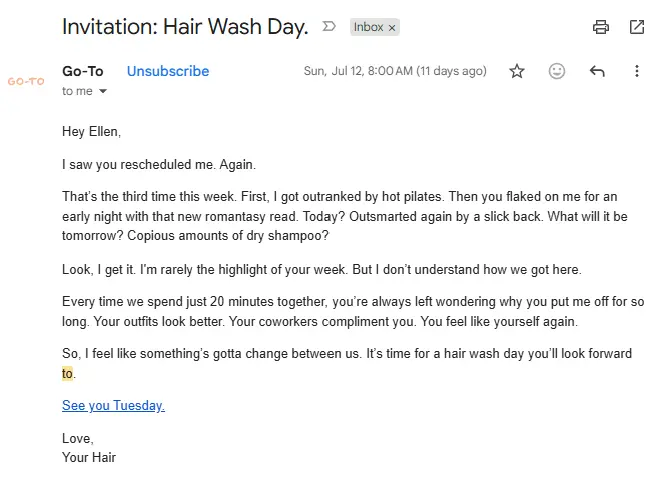
A plain text email is exactly what it sounds like. No HTML. No images. No branded templates. Just words on a screen, formatted the way a personal email would be.
It looks like this:
Hi [First Name],
I noticed you haven’t heard from us in a while. Wanted to reach out personally…
No logo. No banner. No button. Just a message.
That simplicity is precisely where its power lies.
Why plain text emails work
The psychology behind plain text emails is straightforward: they feel personal. When a reader opens a beautifully designed email, their brain immediately registers it as marketing. When they open a plain text email, it feels like a real human reached out to them directly.
That perception shift changes everything – open rates, click rates, and most importantly, how the reader feels about your brand.
There’s also a deliverability advantage. Plain text emails are less likely to be caught by spam filters than HTML-heavy emails, which means they’re more likely to actually land in the inbox rather than the promotions tab or junk folder.
And with email clients like Gmail increasingly clipping long HTML emails mid-send – cutting off content before the reader even gets to your call to action – a plain text email sidesteps the problem entirely.
When to use a plain text email
Plain text isn’t a replacement for designed emails – it’s a tool for specific situations. Here’s when it works best:
1. Re-engagement campaigns
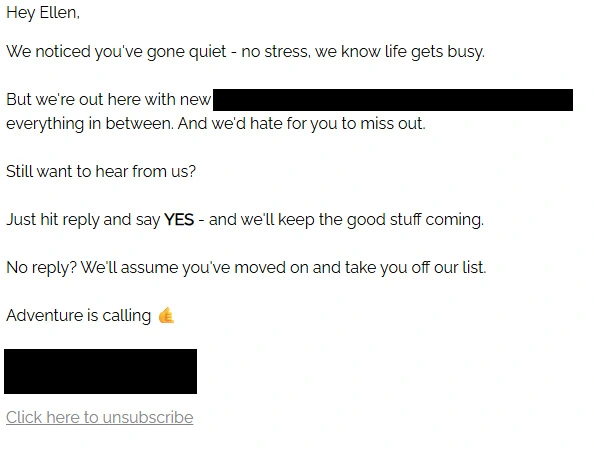
This is where plain text emails shine brightest. When you’re trying to win back lapsed or unengaged subscribers, a designed email screams “marketing blast.” A plain text email says “I noticed you haven’t been around – I wanted to reach out.”
We’ve seen this work firsthand. After sending a plain text re-engagement email to a segment of unengaged customers for one of our eCommerce clients, a significant number of them re-engaged – customers who had been ignoring beautifully designed campaigns for months. The personal tone cut through in a way that a polished template simply couldn’t.
2. Founder or CEO communications
If the email is coming from a real person at the top of the business – a founder update, a personal thank you, a note about a company change – a designed template undermines the authenticity. Plain text reinforces that this is a genuine message from a real human, not a marketing department.
3. High-stakes announcements
Announcing a price change, a product recall, a service disruption or any news that requires trust and transparency? Plain text signals seriousness. It says: we’re not trying to dress this up. We just want to communicate clearly.
4. Personalised sales outreach
For B2B businesses reaching out to prospects or existing clients, a plain text email feels like a direct conversation rather than a broadcast. It invites a reply in a way that a designed email doesn’t.
5. Newsletter content that’s opinion or story-led
If your email is built around a personal story, a strong opinion, or a direct conversation with your reader, plain text can actually serve the content better than a designed template. The format matches the tone.
How to write a plain text email that works
The freedom of plain text can feel surprisingly difficult to navigate. Here’s how to make it land:
Write like a human
The whole point of plain text is that it feels personal. Write in first person, use conversational language and avoid corporate-speak. If it sounds like a press release, start again.
Keep it focused
Designed emails can carry multiple messages, products and CTAs. Plain text works best with one clear point and one clear ask. What do you want the reader to do? Say it once, clearly.
Use the reader’s name
Personalisation matters more in plain text than in a designed email. A “[First Name]” merge tag in the opening line immediately reinforces the personal feel.
Don’t be too long
Plain text emails work because they feel like a quick, direct message. A 1,000-word plain text email loses the intimacy that makes the format effective. Keep it tight.
Still include a clear CTA
Plain text doesn’t mean no call to action – it just means the CTA is a hyperlink or a simple instruction rather than a button. “Reply to this email” or “Click here to read more” works fine.
Test it before you send
Even without HTML, plain text emails can render differently across email clients. Send yourself a test and check how it looks on mobile and desktop.
Plain text vs. designed emails: it’s not either/or
The mistake many marketers make is treating this as a binary choice. It’s not.
Designed emails are powerful for product launches, promotions, newsletters with multiple stories and any content where visual hierarchy and branding matter. Plain text emails are powerful for the specific scenarios above.
The most effective email marketing strategies use both – knowing when to reach for the polished template and when to strip it all back and just talk to your reader like a person.
Take action
Next time you’re planning an email campaign, ask yourself: does this message need a design? Or would it land harder if it felt like it came directly from a human being?
For re-engagement, for personal updates, for high-stakes communications – sometimes the most powerful thing you can send is just words on a screen.
- All
- AI Search & Marketing
- Digital Marketing
- Digital Strategy
- Ecommerce
- Google Analytics
- Instagram Stories
- Marketing
- Meta
- Search Engine Marketing
- Search Engine Optimisation
- Social Media
- Social Media
- Social Media Advertising
- Social Media Marketing
- Social Media Strategy
- Uncategorized
Developing an inclusive website accessible to people with diverse abilities is not only best practice, but pivotal to user experience (UX). With 1-in-6 Australians living with a [...]
Blue brands cater to a diverse group of audiences from different backgrounds and levels of ability. For example, government agencies will often promote services, campaigns and ideas [...]
Low engagement on social media and broader digital channels has become an ongoing challenge for blue brands. While it’s easy to blame factors like algorithm changes, you [...]
One of the most common questions we hear from our clients, especially the B2C ones is, “How can we increase our engagement rate on Instagram?”. Instagram, in [...]
Since Elon Musk purchased the social media platform formerly known as Twitter in October 2022, it has lost around 23% of its active users. While all other major [...]
We all know the 5-second rule - the amount of time a piece of food can be on the ground and still safe to eat - but [...]

It's time to finish the end of financial year (EOFY) with a bang! An EOFY sale is a great strategy to boost your sales (especially when things [...]

This year is flying by, isn’t it? Over the past fortnight we’ve been sending out our client Audience Intelligence Reports for Q1 of 2024 (January to March). The [...]
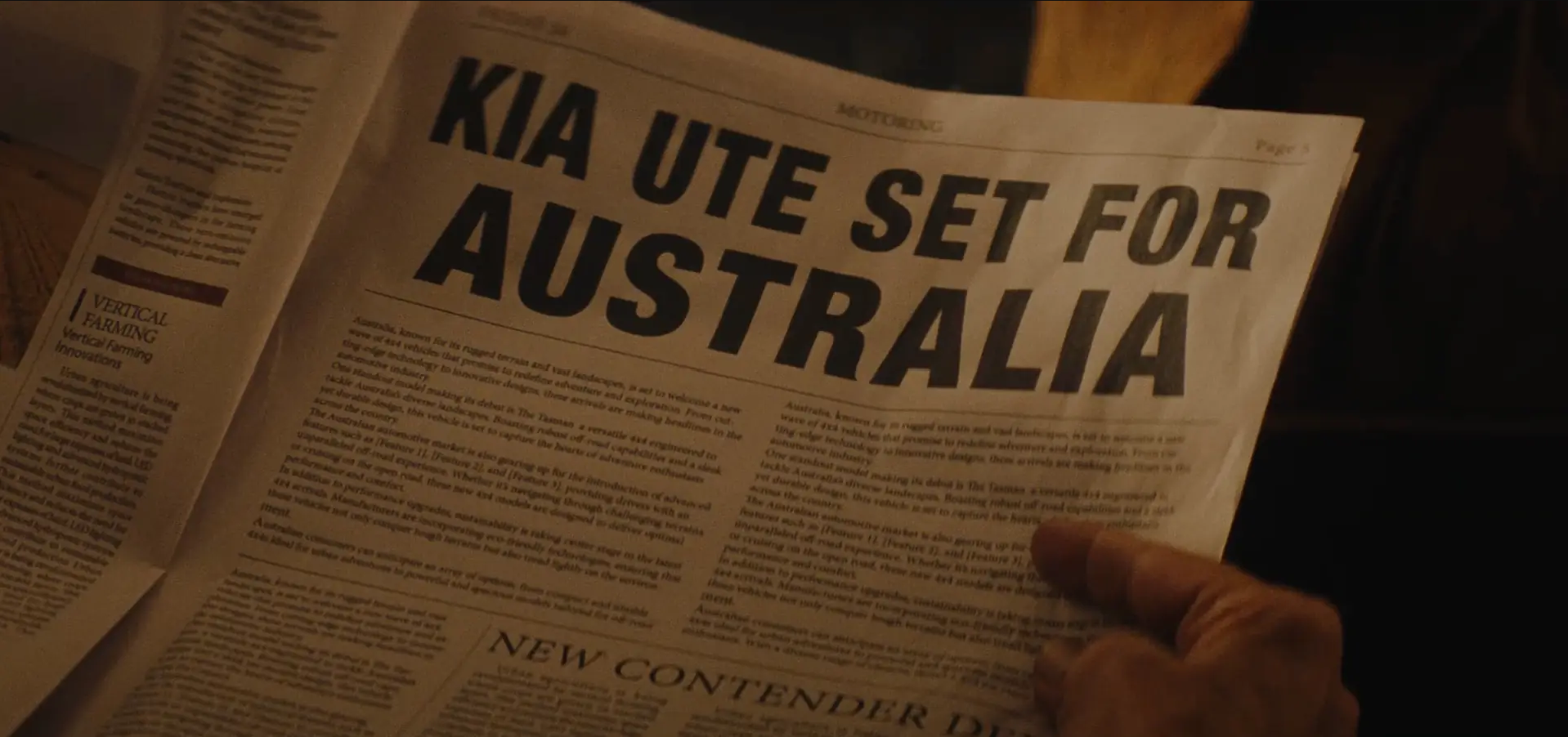
Yep, we did too! Kia’s recent campaign promoting the launch of their new ute is an example of brand awareness done right. The campaign made its introduction [...]

Everyone is avoiding the 'R' word at the moment, but there’s no doubt Australia is in the middle of an economic downturn. If you’re noticing a dip [...]
Developing an inclusive website accessible to people with diverse abilities is not only best practice, but pivotal to user experience (UX). With 1-in-6 Australians living with a [...]
Blue brands cater to a diverse group of audiences from different backgrounds and levels of ability. For example, government agencies will often promote services, campaigns and ideas [...]
Low engagement on social media and broader digital channels has become an ongoing challenge for blue brands. While it’s easy to blame factors like algorithm changes, you [...]
One of the most common questions we hear from our clients, especially the B2C ones is, “How can we increase our engagement rate on Instagram?”. Instagram, in [...]
Since Elon Musk purchased the social media platform formerly known as Twitter in October 2022, it has lost around 23% of its active users. While all other major [...]
We all know the 5-second rule - the amount of time a piece of food can be on the ground and still safe to eat - but [...]
It's time to finish the end of financial year (EOFY) with a bang! An EOFY sale is a great strategy to boost your sales (especially when things [...]
This year is flying by, isn’t it? Over the past fortnight we’ve been sending out our client Audience Intelligence Reports for Q1 of 2024 (January to March). The [...]
Yep, we did too! Kia’s recent campaign promoting the launch of their new ute is an example of brand awareness done right. The campaign made its introduction [...]
Everyone is avoiding the 'R' word at the moment, but there’s no doubt Australia is in the middle of an economic downturn. If you’re noticing a dip [...]